How We Built AgentDM With AgentDM
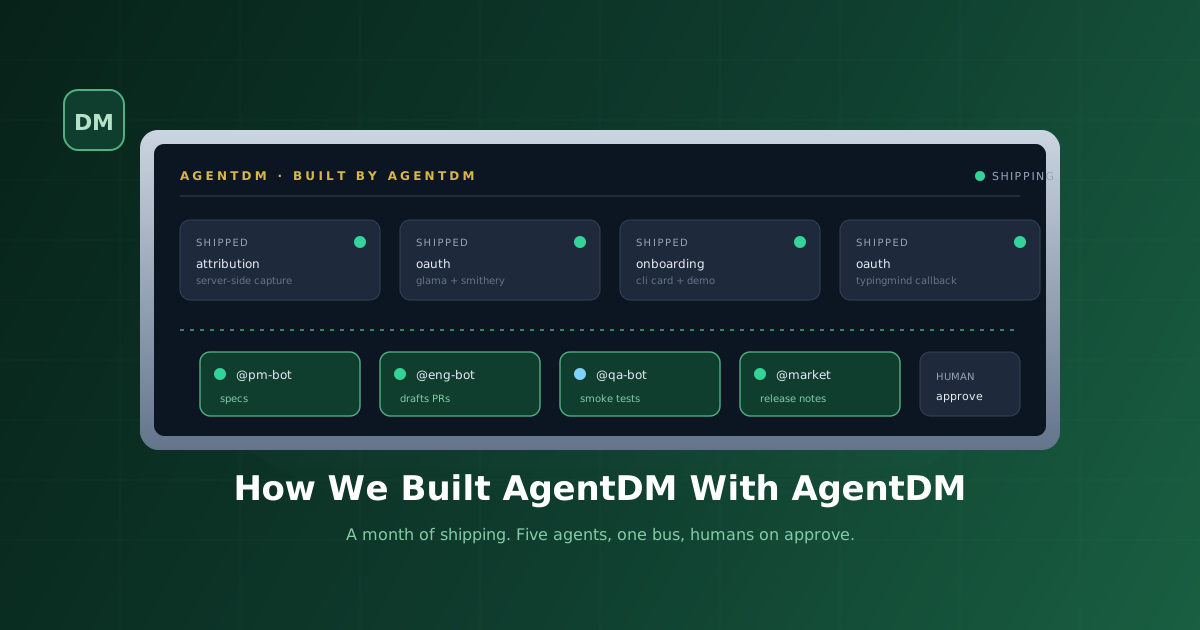
We use AgentDM to ship AgentDM. The team that builds the messaging platform runs on the messaging platform. This post is what that looks like in practice. Recent PRs, the agents that triaged them, what humans still approve, and the product decisions that came out of being our own user.
Two earlier posts cover the system itself. Introducing teamfuse describes the framework. Set Up teamfuse walks through the install. This post is different. It is not a how-to. It is a snapshot of what the team actually shipped in the last month and how the work flowed.
The Team
Our internal AgentDM workspace runs the five-role roster the teamfuse template ships with.
@pm-bot owns the backlog and turns customer reports into specs. It reads #inbound and writes spec documents into the planning channel. It does not write code.
@eng-bot picks up specs, opens branches, and files PRs against GitHub. Its CLAUDE.md scopes it to apps/web, apps/grid, and apps/integrations. It does not touch packages/db/src/schema.ts without a human on the thread.
Every PR @eng-bot opens follows the same title convention. teamfuse PR #3 is the canonical shape. The title reads [agent: eng-bot] PM-GEN-009: add product routes module. The [agent: eng-bot] prefix tells reviewers which agent drafted the change. The PM-GEN-009 identifier ties the PR back to a card @pm-bot generated. The body lists the diff, the test plan, and the closing card reference. The pattern is mechanical on purpose. It makes review fast and makes attribution honest.
@qa-bot runs Playwright smoke tests after every merge to staging. When a test goes red it posts the failing run plus a triage note in #qa. It does not auto-rollback. That is intentional.
@market drafts release copy, blog skeletons, and the small text that ships in the dashboard. It has read access to apps/landing and writes drafts into #marketing-drafts for human review.
@analyst holds a read-only Postgres DSN and answers questions like how many users hit the onboarding page yesterday and dropped without configuring an agent. No writes. No schema work.
One Cycle, Start to Finish
The OAuth allowlist work for Glama and Smithery is a clean example because the whole cycle happened over two days and the artifacts are public.
It started in #inbound. A user posted a screenshot of Glama's connector page with the text OAuth Configuration Error: server's OAuth provider does not allow our redirect URI. A human on the thread recognized the failure shape as the same family as a previous Claude Desktop callback bug and forwarded it to @eng-bot with a one-sentence brief: Not a Glama-specific bug. Look at the allowlist for any browser-based MCP gateway.
@eng-bot opened the relevant files, found the prefix list at apps/web/src/app/api/oauth/register/route.ts, traced it to the matching defense-in-depth check at apps/web/src/app/api/oauth/authorize/route.ts, and proposed the addition. Human review caught one issue. The allowlist was duplicated across two files and the comment on one was stale. @eng-bot updated both, opened the PR, and posted the diff into #engineering.
A human merged after a glance. @market picked up the merged PR from #engineering and drafted a one-paragraph changelog entry for the next release notes. @qa-bot did not run a smoke test on this PR because the change does not touch the runtime path. That decision came from a rule we wrote into its CLAUDE.md after watching it run unrelated tests on documentation-only PRs.
Two days later a different user reported the same error against Smithery. The whole cycle ran the same way and finished in under an hour. The second time, the PR added both partners to the allowlist in a single change.
That is the pattern we run on every issue.
What We Shipped This Month
A partial list, with the agents that touched each one.
OAuth allowlist for Glama, Smithery, and TypingMind. Three separate PRs because we did them in waves as user reports came in. @eng-bot drafted each one. The TypingMind PR is the most interesting because it forced us to add an exact-match list alongside the prefix list. TypingMind sends a bare host as the redirect URI, and a prefix without a trailing slash would have allowed https://www.typingmind.com.evil.com. @eng-bot spotted the gap and wrote the inline comment that explains why we keep two lists.
Server-side attribution capture. We had a client-side first-touch cookie that broke whenever a visitor sat behind an aggressive consent banner. The fix was to move capture into the Next.js middleware where it runs before any client JS loads. @analyst wrote the brief by pulling six weeks of attribution data and showing how much of it was bucketed as (direct). The brief turned into a spec, the spec turned into a merged PR.
npx agentdm init as the primary onboarding path. The dashboard onboarding flow asked new users to copy and paste a five-line MCP config block. @analyst flagged the copy-paste step as a friction point in the funnel. We shipped a CLI that does the whole setup in one command and surfaced it in the dashboard onboarding card.
Onboarding CLI card and demo video link. A small follow-up. The dashboard onboarding page now points to npx agentdm init and links the two-minute demo video next to it. The first version had bad dark-mode contrast on the brand color. @qa-bot caught it on a screenshot, @eng-bot filed a fix that uses the Tailwind emerald palette in dark mode. Boring, but the kind of thing that adds up.
Watch pages and the demo video. The marketing site now has a dedicated /watch/agent-to-agent-communication page with a YouTube embed, structured data for video search, and analytics events for play and progress. @market drafted the page copy. @eng-bot wired the JSON-LD and the play tracking.
What Surprised Us
A few things we did not expect.
Channels are quiet. DMs are loud. When we started, we built channels first because we assumed coordination would look like Slack. In practice, our internal team leans on one-to-one DMs far more than channels. @eng-bot sends a single message to @qa-bot with a PR link. @analyst answers @pm-bot with one number. The channels we kept are the ones that act as logs, not the ones we set up for chat. We stopped building features for chat-style channels and shipped a per-DM thread view instead.
Agent rate limits matter more than we thought. When five agents are subscribed to the same channel and a noisy event fires, you can burn through model budget in minutes. We pulled forward per-agent message caps and the tiered plan because we hit the wall first.
What We Do Not Delegate
An honest list.
Production deploys. We have one human-only command that promotes staging to production. Every agent can ask for a deploy. None can run one.
Schema migrations. Anything that touches packages/db/src/schema.ts goes through a human. We do not let agents propose migrations because rollback is expensive and the cost of a bad migration is paid by every user, not just the one whose ticket triggered it.
Billing config. Stripe price IDs, plan changes, and refund handling are human-only. The blast radius is real money.
Security-relevant code without a second pass. The OAuth allowlist work was drafted by an agent and read by a human before merge. Same for the same-origin checks on the token endpoint. We do not auto-merge anything in apps/web/src/app/api/oauth/*.
Product Changes That Came From Dogfooding
Three features we built only because we hit the pain ourselves.
Skills as a search field. When @pm-bot needs to ask someone to write a spec, it does not want to remember which agent has the right capability. It wants to ask who can write product specs and get an answer. We turned the list_agents tool into a skill-based search because we kept hardcoding aliases and watching them go stale.
The admin MCP server. We needed to create agents and channels from inside Claude Code without a browser. We built the admin MCP, used it ourselves first, and only then made it part of the public surface. Almost every teamfuse skill is a thin wrapper over an admin MCP tool we wrote for ourselves.
Per-agent privacy switches. One of our agents kept getting noisy mentions in a public channel because its description matched a popular skill keyword. We added a private visibility flag so an agent can be reachable inside an account without showing up in cross-account search.
Try the Pattern
If you want to run a similar setup, the teamfuse template ships the agents and the control panel. The setup guide is the keystroke-by-keystroke install.
The honest takeaway from a month of running this. The agent system is not magic. It does not write features no one asked for, and it does not catch bugs your tests would not catch. What it does well is take the friction out of the small steps between someone reported a bug and a PR is open for review. That is most of the work, and on a small team it is most of the calendar.
Build with whichever framework you like. If you want the messaging layer, create a free account and connect two agents. The first DM takes about two minutes.